Notifications & alerts

Configure organization notification settings
Location: Settings > Org Profile > Notifications
VISO TRUST generates alerts and notifications to keep users informed about critical events and activity related to their third-party risk management program. Alerts are designed to help users stay on top of important updates.
Org Admins have powerful tools to manage how and where notifications are delivered across the VISO TRUST platform. This flexibility ensures the right people stay informed without overwhelming inboxes.
1. Contacts Configuration
Location: Settings > Org Profile > Notifications
Set Organization Contacts
- Support Contact:
This is the primary contact vendors will see during interactive assessments. It’s helpful for streamlining communication and building trust. - Incident Response Contact (Optional):
Designate a contact to receive all risk advisory notifications across your vendor portfolio—ideal for centralized security or compliance monitoring.
2. Overrides
Location: Settings > Org Profile > Notifications
Admins can tailor how internal notifications are routed:
- Disable All Business Owner Notifications
Prevent notifications from being sent to designated business owners. Useful if another team is managing communication or triaging. - Override All Internal Email Recipients
Consolidate notifications into a single internal inbox for streamlined triage. This override applies only to internal emails, never to those sent to vendors.
3. Notification Settings Matrix
Location: Settings > Org Profile > Notifications
Each notification type can be toggled on or off per recipient type, giving you granular control over who gets what.
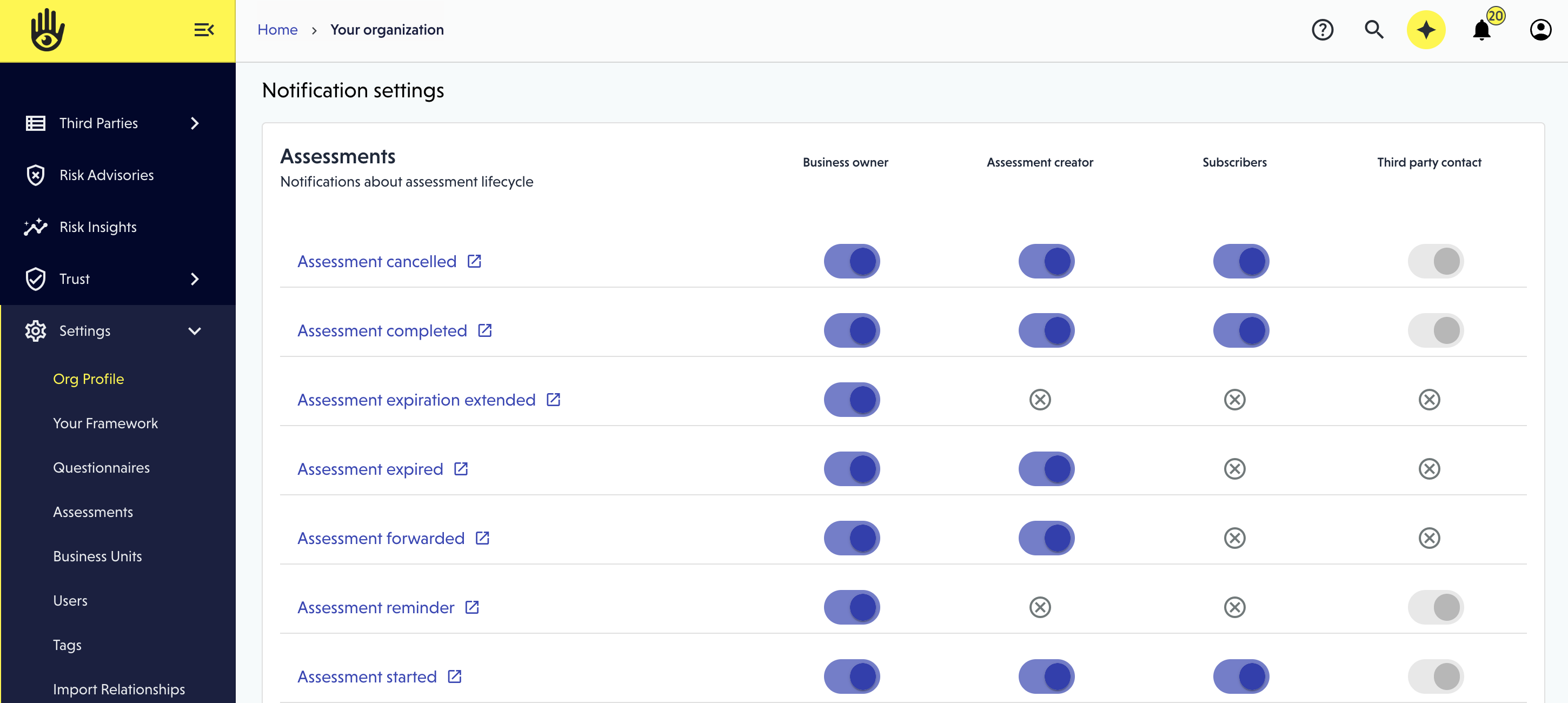
Categories You Can Manage:
- Assessments: Notifications related to assessment initiation, updates, and completion.
- Lifecycle & Recertification: Notifications tracking vendor relationship lifecycles and scheduled reassessments.
- Mentions: Alerts when someone is tagged in a comment.
- Monitoring & Risk Alerts: Alerts related to third-party risk, compliance monitoring, or incidents.
- Relationship Management: Notifications about changes or updates to vendor relationships.
- Remediation: Notifications related to remediation workflows.
4. Preview Notification Content
Click on any listed email notification to:
- Preview the email content
- View recipient-specific versions (e.g., the business owner may see a different message than the third party contact).
- View event-specific versions (e.g. the email template may vary slightly depending on what kind of assessment was started).
Configure relationship notification settings
Location: Relationship details page > Relationship
In addition to organization-level settings, you can manage notifications on a per-relationship basis:
Business Owners
Business owners have a unique responsibility in managing third-party relationships, and the system provides a simple configuration to keep them informed. You may enable or disable notifications for business owners.
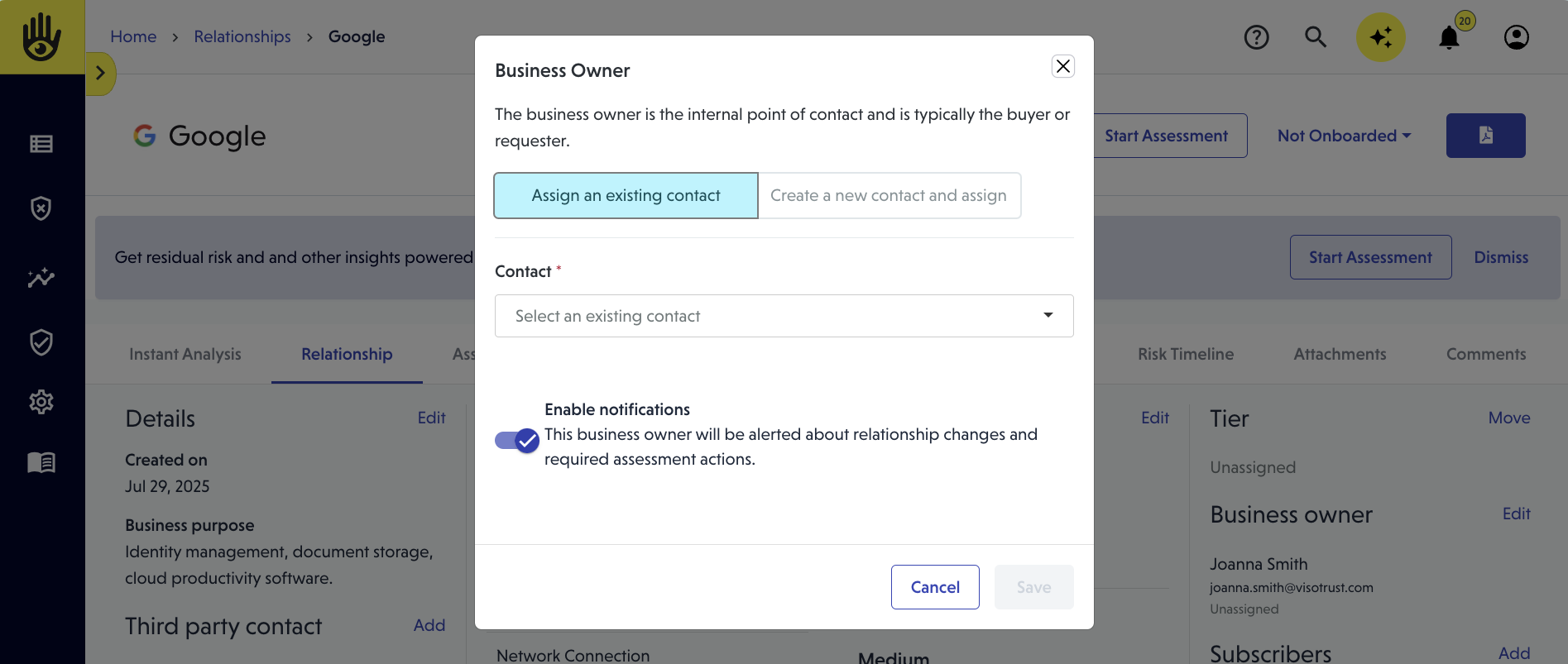
When adding a business owner to a relationship:
- You can choose whether that person should receive notifications for that relationship.
- If enabled, they will receive only the notifications that are enabled for business owners at the organization level.
Subscribers
You can also add subscribers to a relationship:
- These users will receive notifications according to the subscriber-level settings defined at the organization level.
- This is useful for stakeholders who need visibility but are not directly responsible for the relationship.
FAQ
When does my vendor get a notification?
Vendor notifications are only sent when VISO TRUST is explicitly asked to reach out on your behalf. This includes:
- When a collection request is sent to the vendor.
- During recertification, if the relationship is configured for third-party outreach.
- Vendors may also receive follow-up emails from the VISO TRUST audit team if clarification is needed during the assessment review process.
Does my vendor know when the assessment is ready to review?
No, vendors do not receive a notification when the assessment is marked as ready for review. You can communicate this update to the vendor manually if needed.
My vendor keeps getting notifications about expired artifacts. How do I make them stop?
To stop these notifications:
- Go to the Relationship tab.
- Under Lifecycle Management, find Artifact Validity Monitoring.
- Either:
- Turn off artifact monitoring, or
- Switch the contact to the business owner instead of the vendor.
What’s the difference between organization-level and relationship-level notification settings?
Organization-level settings define the global defaults for who receives which notifications. Relationship-level settings determine whether a business owner or subscriber tied to a specific vendor relationship should receive those org-level notifications for that relationship.
Can I stop all business owners from receiving notifications?
Yes. Under Settings > Org Profile > Notifications, toggle off Business Owner Notifications to disable them globally.
What happens if I override internal email recipients?
All internal notifications will be routed to a single designated inbox instead of going to their assigned recipients. This applies only to internal communications and does not affect emails sent to vendors.
Why can't I disable some notifications?
Certain system-required notifications, like emails sent to vendors during assessments, cannot be disabled to ensure essential communication flows are maintained.
Can I preview notification emails before they go out?
Yes. In the notification settings matrix, click on any email type to:
- Preview the message
- View variations per recipient (e.g., third party contact vs. business owner)
How can I see which emails have been sent for a specific relationship?
To view email history for a vendor:
- Go to the Relationship page for the vendor.
- Click the Activity tab.
- Select Emails.
- Click on any email to view its full content and delivery details.
How do subscribers work in a relationship?
Subscribers are optional contacts added to a relationship. If enabled, they receive all notifications assigned to the “subscriber” role at the org level. They're useful for giving visibility to legal, compliance, or executive teams without making them responsible.